
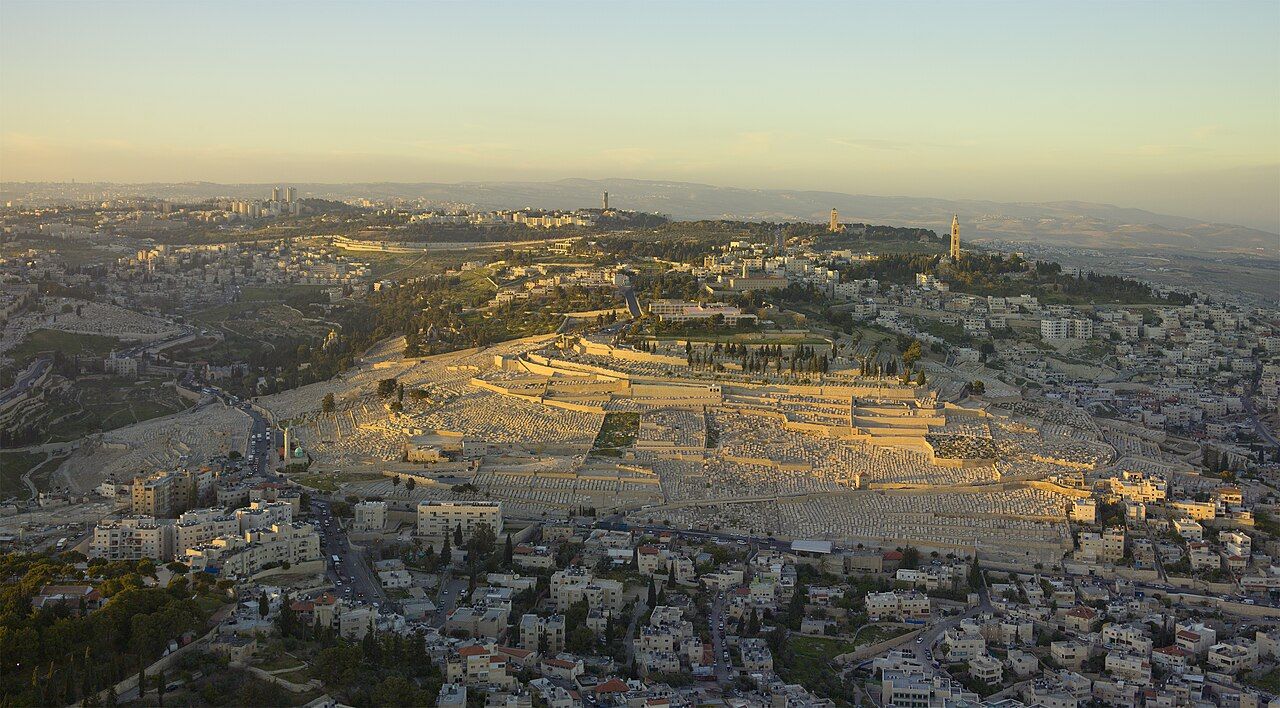
The Mount of Olives is the long ridge facing the Old City across the Kidron Valley. It has been a place of burial, prayer and pilgrimage for thousands of years, and the walk down its western slope links a string of sites that matter to both Jews and Christians. The road is steep enough that walking up it in the heat is hard work, so the simple trick is to get to the top first and then walk down.
The Mount of Olives lies in East Jerusalem, whose status is disputed internationally, and the neighbourhood of a-Tur sits on the summit. As anywhere in the region, check your own government's current travel advice before you set out, and follow any instructions from local police or staff at the sites.
The viewpoint at dawn
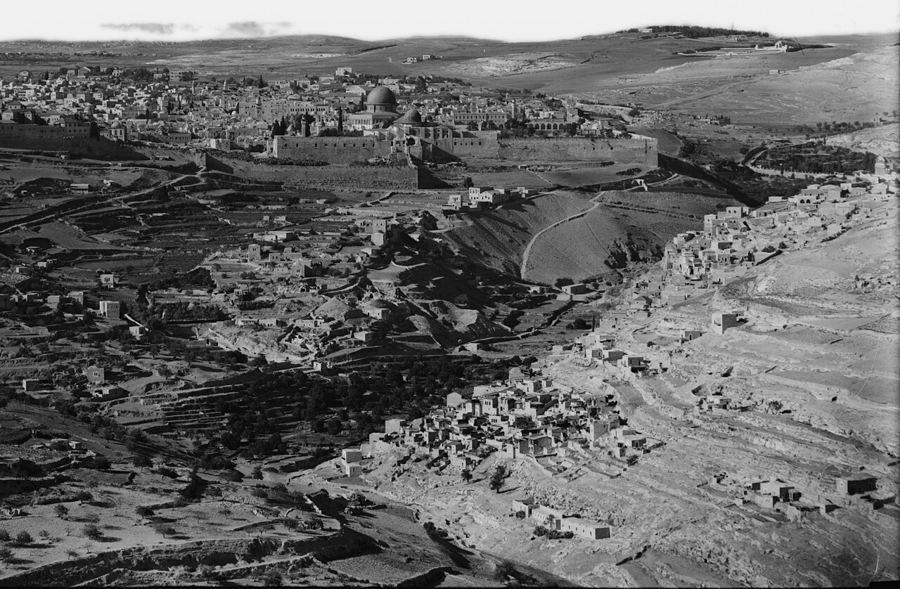
Near the top, a terrace just below the road looks straight across at the Old City walls. In the first hour after sunrise the light comes from behind you and falls on the gold Dome of the Rock, the grey dome of al-Aqsa, the towers of the churches and the long line of the walls. It is one of the most photographed views in the country, and it is calmest early, before the tour buses pull in.
From here you can trace the geography that the rest of the walk explains. The Kidron Valley runs below you, the Temple Mount platform rises on the far side, and the hill of the City of David drops away to the south. Take a few minutes to match what you see with a map before you start downhill.
The Jewish cemetery
Below the viewpoint, the slope is covered by a vast Jewish cemetery, thought to be the oldest still in use anywhere. Rows of flat stone tombs face the Temple Mount, in line with a tradition that the resurrection of the dead will begin here. Prime ministers, rabbis, poets and ordinary families are buried side by side.
A path runs down through the graves. Walk it quietly, keep to the paths, and do not climb on tombs to get a better photo. Visitors often place a small stone on a grave as a mark of remembrance rather than flowers. If a funeral is taking place, keep a respectful distance.
Dominus Flevit
About halfway down, a gate on the right leads into the grounds of Dominus Flevit, a small Franciscan church whose name means "the Lord wept". It recalls the Gospel passage in which Jesus weeps over Jerusalem. The present building, completed in the 1950s to a design by the Italian architect Antonio Barluzzi, is shaped like a teardrop, with a small dome and corner urns.
Inside, the window behind the altar frames the Old City, so the view becomes part of the church itself. Excavations in the grounds uncovered ancient tombs and the remains of an earlier Byzantine chapel. Opening times are short and break for a midday pause, so plan to arrive mid-morning.
 Another day · JerusalemInto the water beneath the ridge
A little further down, on the same side of the road, the gold onion domes of the Russian Orthodox Church of Mary Magdalene rise above the trees. It is a convent, open to visitors only on limited days, but you see it well from the lane.
Gethsemane and the Church of All Nations
At the foot of the slope, near the main road, lies the Garden of Gethsemane, where the Gospels place the prayer of Jesus on the night before his arrest. A small walled garden holds olive trees with gnarled, split trunks; some are very old, and scientists have dated parts of their wood to the medieval period. You view the garden from a path around it rather than walking among the trees.
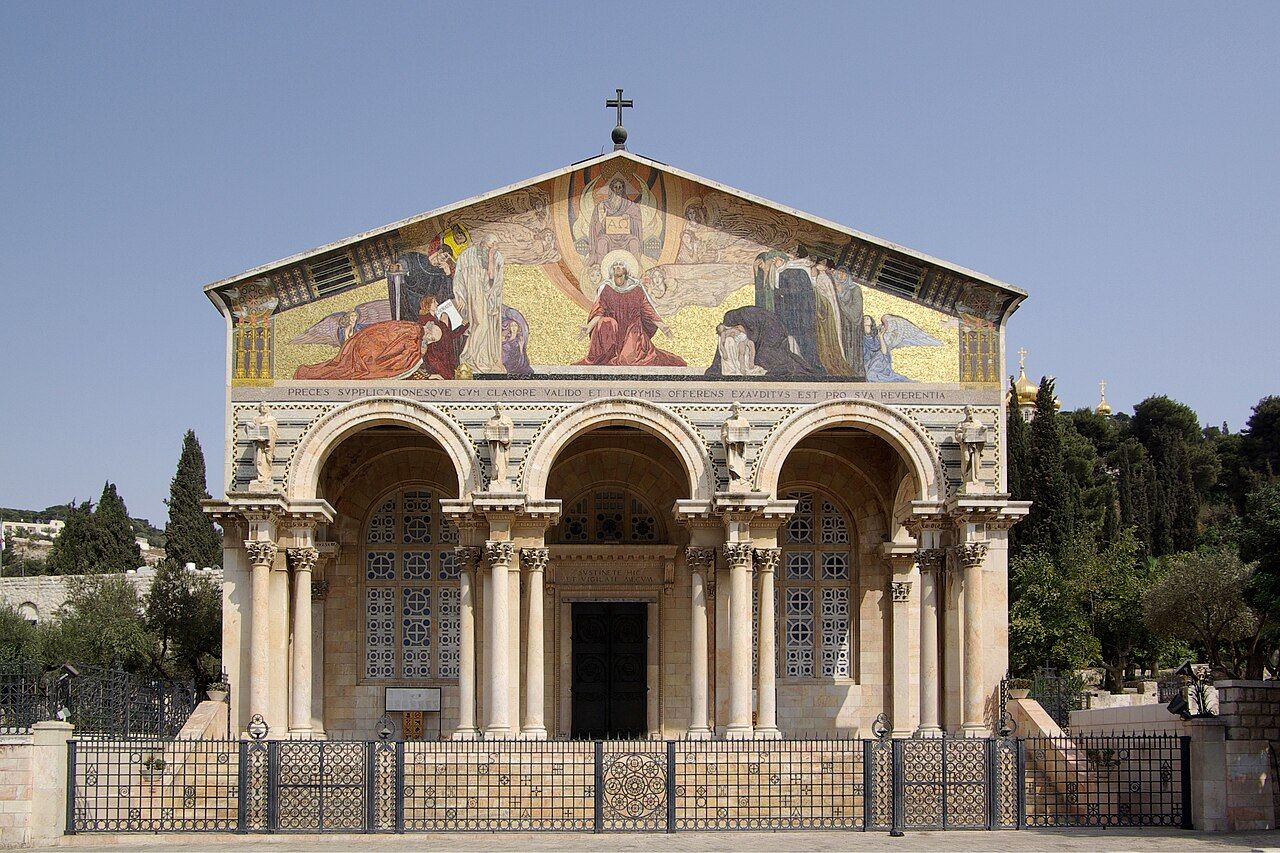
Next to it stands the Church of All Nations, also called the Basilica of the Agony, finished in 1924 and also designed by Barluzzi. Its name comes from the many countries that helped pay for it, whose emblems appear in the ceiling domes. The facade carries a large mosaic above a row of columns. Inside, the light is kept dim through violet glass, and a section of bare rock before the altar is venerated as the place of the agony. Speak quietly, cover your shoulders and knees, and do not photograph during services.
Just across the road and down a flight of steps is the Tomb of Mary, a dim underground church held by the Greek Orthodox and Armenian churches, with lamps hanging from the ceiling. Muslims also honour the site, as Mary is revered in Islam.
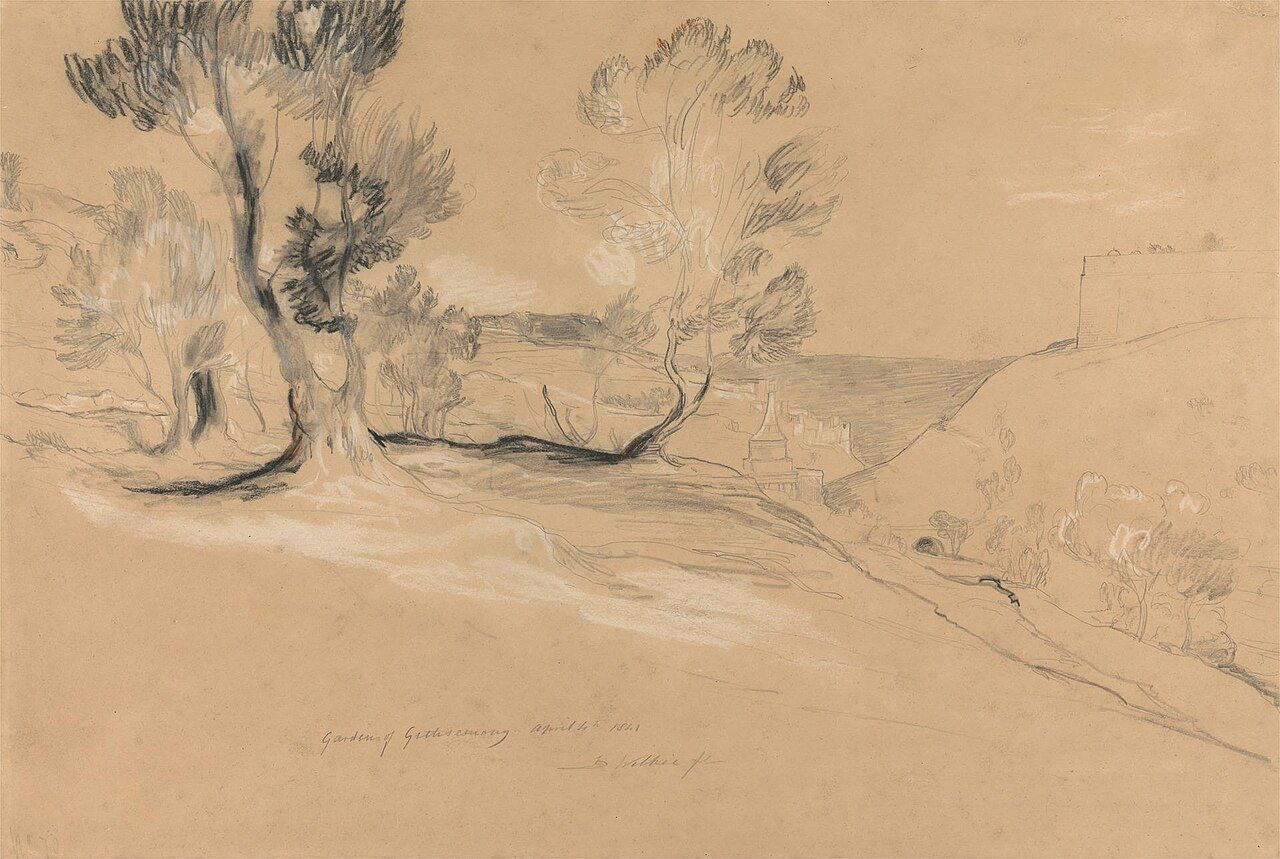
An older view of the garden survives in drawings by nineteenth-century artists who came to sketch the slope.
Practical points
The walk from the viewpoint to Gethsemane is under two kilometres but drops steeply on a narrow, walled lane with patches of loose surface. Wear shoes with grip, especially after rain. There is little shade on the upper half, and few places to buy water, so carry what you need.
Traffic on the lane is light, but cars and minibuses do use it, so keep to the side where the walls narrow it. Keep valuables out of sight, as you would in any busy place, and follow any directions from police or site staff.
From Gethsemane it is a short climb up to Lions' Gate (St Stephen's Gate) and into the Old City, where you can continue through the Old City quarters. Alternatively, follow the Kidron Valley south toward the City of David and its water tunnel. If you need a quiet afternoon after all this, the Israel Museum and Yad Vashem make a contrasting second half; the guide to the Israel Museum and Yad Vashem covers timing.