
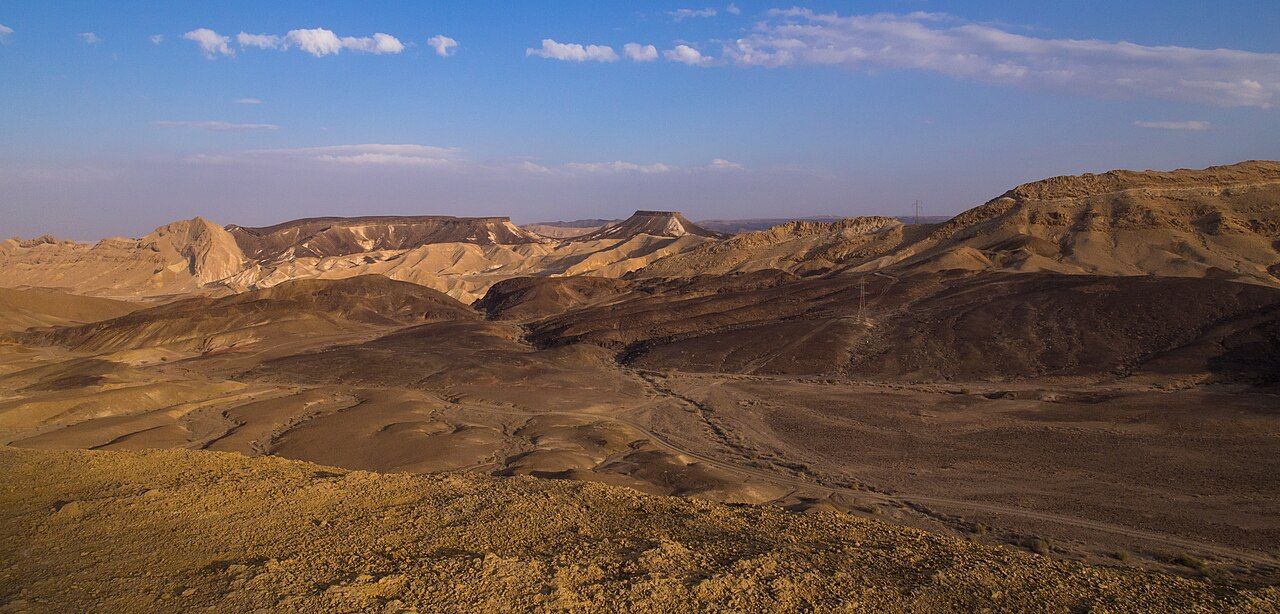
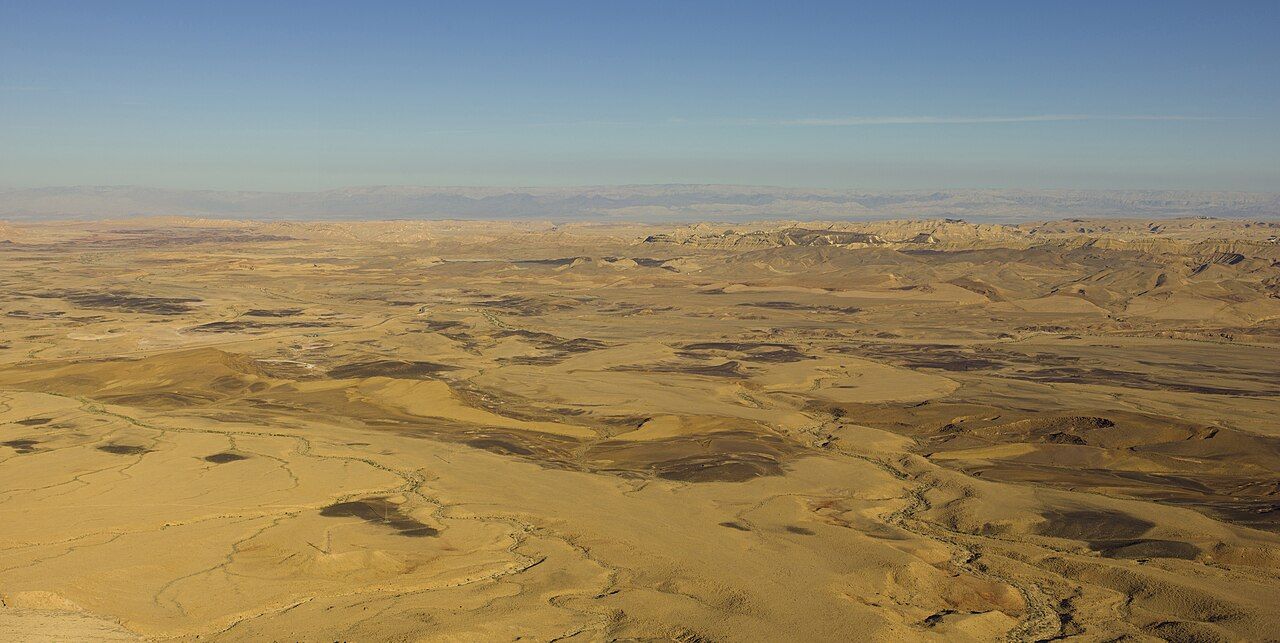
Mitzpe Ramon is a small town set right on the northern edge of Makhtesh Ramon, the largest of the Negev's erosion craters. You step out of the last row of streets and the ground simply drops away: cliffs falling hundreds of metres to a wide basin of coloured sand, black hills and pale ridges stretching out to the south. Few places in Israel give such a sudden sense of space.
The word makhtesh is Hebrew and has become a term in geology for this kind of landform. A makhtesh is not an impact crater and not a volcano. It forms where a hard outer layer of rock caps softer layers below; once erosion breaks through the hard cap, water carries away the soft rock underneath much faster, hollowing out a steep-walled valley drained by a single channel. Makhtesh Ramon is around forty kilometres long and up to about ten kilometres wide, and its floor exposes rock layers that are rarely seen at the surface.
The rim at first light
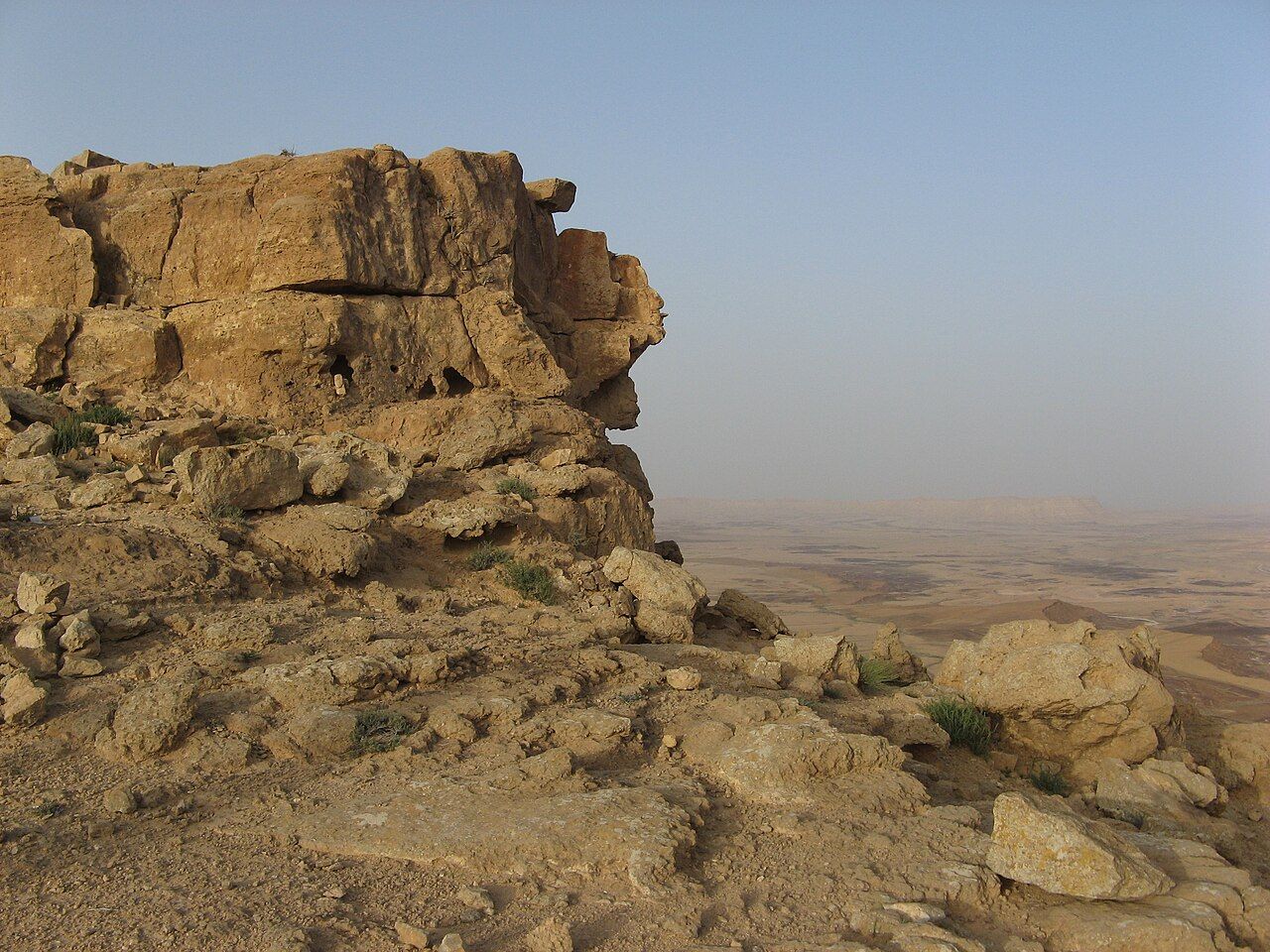
A promenade runs along the cliff edge on the town's side, with lookouts and benches facing south. At sunrise the light rakes across the crater floor from the east, picking out each ridge and gully, and the colours change by the minute. It is cool, quiet and usually empty, and worth setting an alarm for.
The visitor centre stands on the rim near the town's main road. It explains the geology and the wildlife of the crater and includes a memorial to Ilan Ramon, the Israeli astronaut who died in the loss of the space shuttle Columbia in 2003. Hours and entry rules at the centre shift from year to year, so confirm them before the drive south. Rangers there can tell you which trails are open and what the day's heat will allow.
Into the crater
Route 40, the main road south to Eilat, drops from the town down the northern wall in a series of switchbacks and crosses the floor of the crater. With a car you can reach several well-known stops on short side tracks, each with walks of an hour or two.
- The Carpentry. A low hill covered in dark prism-shaped rocks, formed when sandstone was baked by volcanic heat and then cracked into columns. A short trail circles it on boardwalks.
- The Ammonite Wall. A rock face holding hundreds of fossil ammonites, the coiled shells of sea creatures from the time when this land lay beneath an ancient ocean.
- Mount Ardon. A longer climb to a summit inside the crater, with views back towards the northern cliffs. Start early and carry plenty of water.
- The coloured sands. Patches of sand in yellow, red, purple and white, eroded from different layers, near the crater floor.
Some longer routes, including sections of the Israel National Trail, descend the cliffs on steep paths. These need a full day, good fitness and a clear plan for getting back out, which usually means arranging a pick-up or walking a loop. Trails are marked with painted stripes on rocks; carry a paper map as well as your phone, because coverage can drop out on the crater floor.
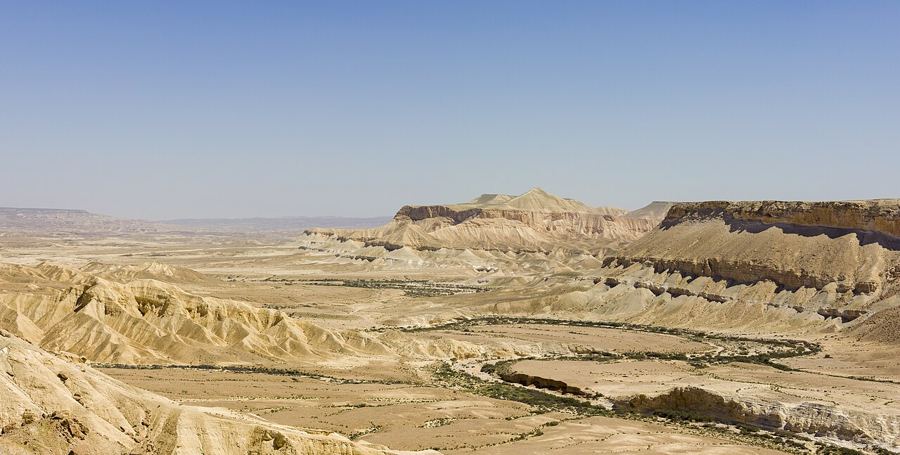 Another day · NegevAvdat and the Incense Route
Ibex, heat and water
Nubian ibex live on the cliffs and wander into town, grazing on gardens and resting in the shade of buildings, and you are very likely to see them near the rim. They are wild animals. Keep your distance, do not feed them, and give the males with their long curved horns plenty of room.
The desert here is unforgiving in heat. Summer days are very hot on the crater floor, even though the town on the rim is cooler at night thanks to its height of around nine hundred metres. The rules are simple and they matter:
- Carry at least three litres of water each for a half-day walk, more in warm weather, and drink before you feel thirsty.
- Start walking at first light and be off exposed trails by late morning from late spring to early autumn.
- Wear a hat, long sleeves and sturdy shoes; the rock is sharp and loose in places.
- Check the forecast for winter rain. Flash floods can rush down dry channels from storms far away, so never camp or linger in a stream bed when rain is possible.
Rangers may close trails on very hot days or after heavy rain. If a sign says a route is closed, respect it.
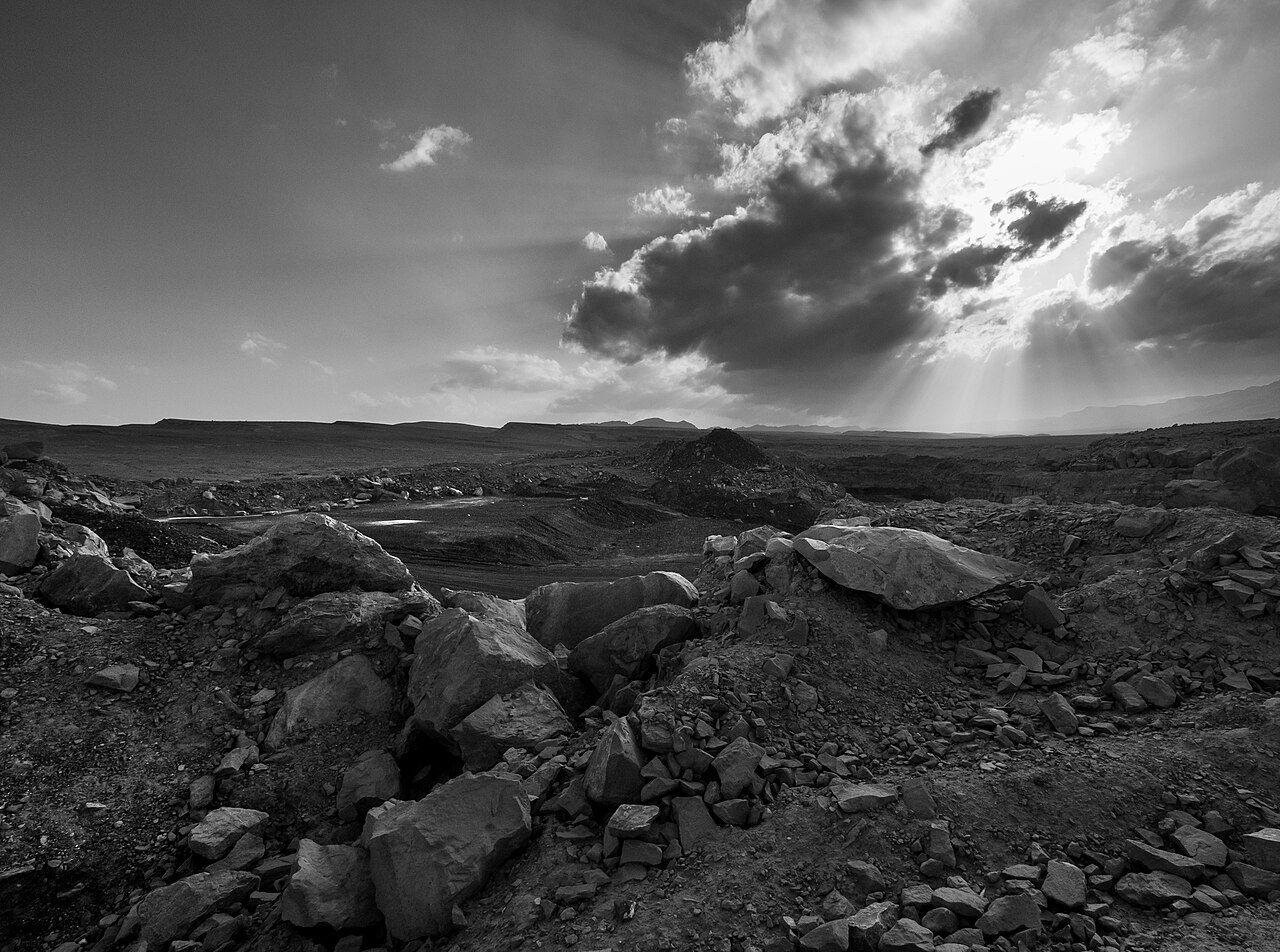
The crater is also a working landscape with a long human story. Small quarries for sand, clay and gypsum operated here in the twentieth century, and their scars are still visible, while far older tracks crossed the basin when caravans moved through the Negev with incense and spices.
Dark skies
With little light pollution and dry air, Mitzpe Ramon has some of the darkest skies in Israel. On a moonless night the Milky Way stretches clearly across the sky over the crater. You do not need a telescope: walk a few minutes away from the streetlights to the rim, let your eyes adjust for twenty minutes, and the sky fills in.
Nights are cold for much of the year, especially from November to March, when temperatures can fall close to freezing. Bring a warm jacket and a hat even if the day felt hot. Keep a red-filtered headlamp to protect your night vision, and stay well back from the cliff edge in the dark.
On a moonless night the Milky Way stretches clearly across the sky over the crater.
Planning the day
Mitzpe Ramon lies about an hour and a quarter south of Beersheba on Route 40, and roughly two hours north of Eilat. Buses run along the road between the two, but stop on Shabbat. A car gives you far more freedom for the crater stops, which are spread out and lie off the bus route.
A good shape for a single day: the rim at dawn, the visitor centre when it opens, a drive down to the Carpentry and the Ammonite Wall before the heat builds, a long rest at midday, then the rim again for sunset and the stars. If you are driving the whole Negev road, combine this with a morning at Avdat and Ein Avdat to the north, or continue south to Timna Park and the Red Sea.
The town is small and fairly quiet, with a scatter of places to eat and stay, a supermarket for water and food, and a growing area of studios in an old industrial quarter. Fill up with fuel before driving south, since stations are far apart. And keep in mind the advice in safety and travel advisories: let someone know your route on any desert walk, and check current conditions before each day out.